User profiles
Personal information
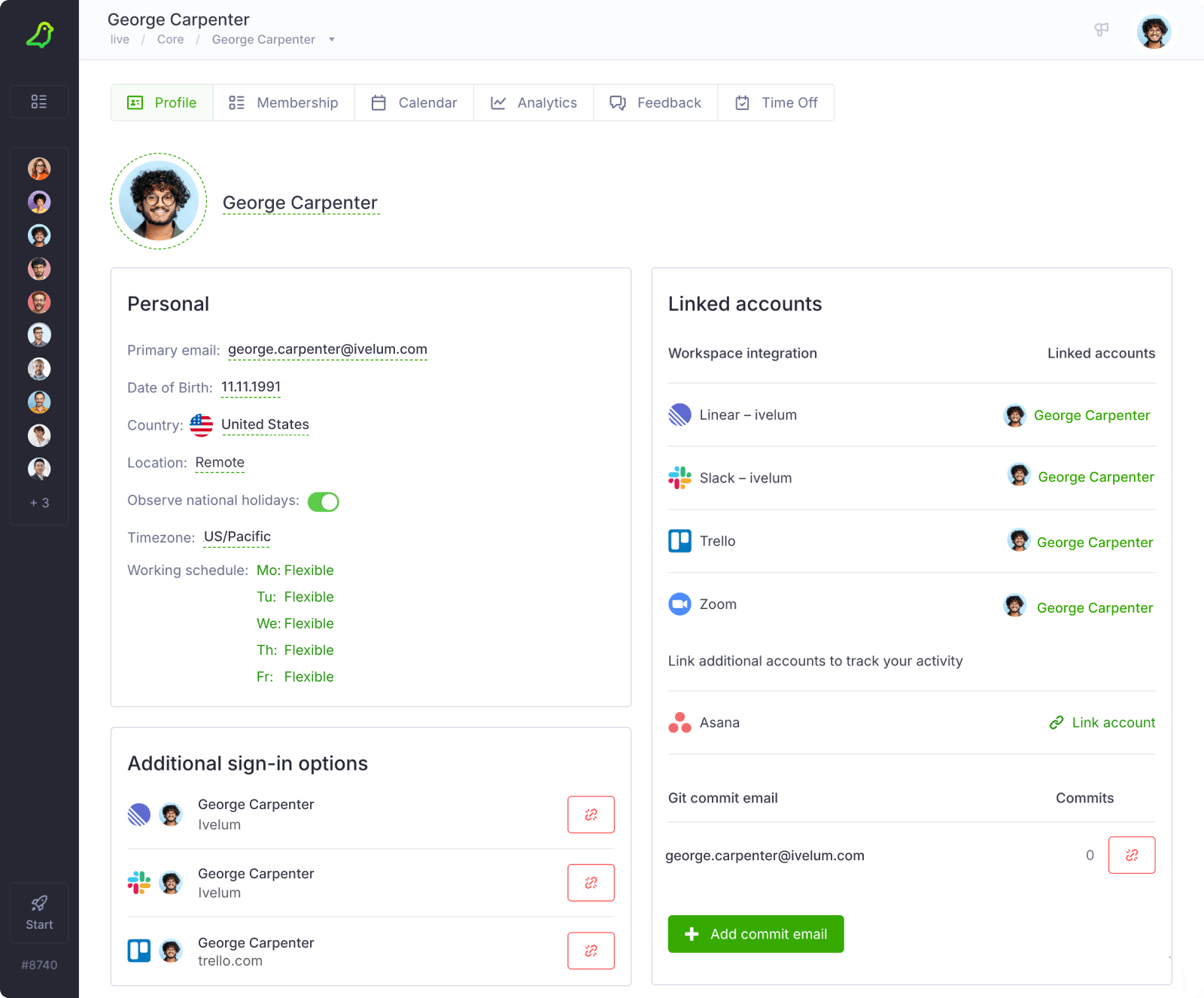
Teamplify stores the following personal user information:
- Full name - helps teammates identify each other in the interface and system messages.
- Primary email - used for signing in to Teamplify and receiving system notifications.
- Date of Birth (optional) - if provided, the user's birthday appears on their personal and team calendars and includes them in “Birthday” notifications, if enabled.
- Timezone - ensures accurate timing for working schedule, notifications, standups, and other time-based features.
- Avatar - Teamplify automatically pulls user avatars from linked accounts and lets them choose which one to use in the Teamplify interface.

Additional sign-in options
In addition to email, users can sign in using any supported Single Sign-On (SSO) provider, such as Google, Microsoft, GitHub, Okta, and others. The Additional sign-in options section in the user profile allows linking these accounts to their Teamplify profile to enable SSO access.
Country and location
As part of its Time Off Management feature, Teamplify includes built-in national holiday schedules for nearly all countries worldwide. The holiday schedule applied to a user depends on their selected Country, and it is enabled through the Observe national holidays option.
User's Location shows whether they are working remotely or in the office. It can also be used as a filter in the member list, making it easier to find people by their location.
Working schedule
A working schedule defines a team member’s working days and hours based on their time zone. It sets the default weekly schedule, which can later be adjusted for specific days to account for time off requests, national holidays, or custom working days.
Working hours can also be set as Flexible, meaning they aren’t strictly defined and may vary from week to week. Here’s an example, with flexible hours on Wednesday:

Working schedule is used across several Teamplify features, including Smart Standups, Time Tracking, Team Workflows, and Time Off notifications.
Linked accounts
Teamplify works best when integrated with your team collaboration tools, such as Slack, Jira, GitHub, and more. After adding a new integration, make sure all team members have their Linked Accounts set up correctly so that Teamplify can:
- Track each user’s work activity, including tasks in the task tracker, submitted or reviewed pull requests, and participation in meetings.
- Send notifications in team chats or emails that reference the user or their work.

Git commit emails
For developers and anyone who uses Git, Teamplify needs to know which email addresses they use for code commits in order to recognize their work in connected repositories. Linking a GitHub or GitLab account alone isn’t sufficient—it only allows Teamplify to track activity in pull requests and issues. To enable Teamplify to detect code commits, please list the relevant email addresses in the Git commit emails section:

